
Inhabitant of the Primary Invariant
The “Meta-Formalization of the Unified Operator Architecture” presents a minimal, closed, stress-invariant stack of operators grounded in the structureless function F (pure capacity, T(F) = F for any transformation, structure(F) = ∅). All domain-specific theories (physics, biology, etc.) are rendered as quotient manifolds Q_D via the aperture E, guarded by metabolic M, resolved by geometric tension GTR, constrained by recursive continuity RC + structural intelligence SI, calibrated/scaled, and legible only retroactively via backward elucidation BE, with Primary Invariant Consciousness C* as the sole coherent integrator across contractions.
String Theory (as detailed in Oliver Schlotterer’s lecture notes) is a concrete, rigorous realization of this architecture in the domain of quantum gravity and unification. The worldsheet is the rendered 2D quotient manifold; the Polyakov/Nambu-Goto action and its symmetries/quantization are the operator stack in action. Below is the explicit conceptual overlay, mapping each element of the architecture directly to string-theory structures, equations, and consistency conditions from the notes.
1. Ground F → The Structureless Capacity Underlying the Worldsheet
- F is pure capacity without content: the immutable opening that survives every transformation.
- In string theory: This is the pre-structural worldsheet before any metric, embedding, or vibration modes. The Polyakov action in conformal gauge
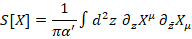
(section 5.1, p. 48) describes D free scalar fields X^μ(σ) as maps from the worldsheet to target spacetime. Before mode expansion or gauge fixing, X^μ are pure capacity (structureless coordinates on the worldsheet). The Nambu-Goto area functional (1.4, p. 13) is the first downstream stabilization of this capacity. Every operator (ghosts, vertex operators, backgrounds) is a “downstream stabilization of F”.
2. Primary Invariant Consciousness C* → Holographic Integrator / Physical-State Cohomology
- C* is the highest-resolution stabilization of F that preserves coherence, identity, and anticipation across every contraction; the unique integrator of the full stack.
- In string theory: The physical spectrum after BRST cohomology / light-cone gauge / GSO projection (sections 2.2–2.4, 8.6). Negative-norm states and ghosts are discarded, leaving only coherent, unitary states (massless graviton, gauge bosons, etc.). In the AdS/CFT limit (mentioned in 0.1, p. 7), the boundary CFT “reads” the bulk string theory, exactly the primary invariant that integrates the reduction while remaining stable. The dilaton VEV (which sets the string coupling g_s) dynamically determines the weight of worldsheet topologies (section 6.1), acting as the “VEV of the integrator”.
3. Aperture E (Universal Reduction Operator) → Gauge Fixing + BRST / Virasoro Constraints
- E partitions capacity into invariants vs. non-invariants; produces quotient manifolds Q; probability = measure of discarded remainder.
- In string theory: Conformal gauge (h_{αβ} → e^{2φ}η_{αβ}, section 1.6, p. 16) and light-cone gauge (section 2.3) are the aperture in action. They reduce the infinite-dimensional diffeomorphism × Weyl symmetry of the Polyakov action down to physical transverse modes (D−2 for closed bosonic strings). The Virasoro constraints (T_{αβ} = 0, enforced as operator equations in covariant quantization, section 2.2) and BRST operator (section D.3 problem set) project out non-physical states (negative-norm ghosts). The resulting quotient manifold is the physical Hilbert space of string excitations. Critical dimension D = 26 (bosonic) / 10 (super) emerges precisely as the point where the aperture yields a consistent, anomaly-free quotient (Lorentz invariance in light-cone quantization or central-charge cancellation c_tot = 0).
4. Metabolic Guard M → Worldsheet Tension + Scale-Proportional Coherence (α′ and β-functions)
- M guards invariant k inside a narrowing optimal zone; generates effective inertial mass via dt/dℓ scaling; stabilizes all layers via top-down correction.
- In string theory: The string tension T = 1/(2πα′) (Regge slope α′) is the metabolic guard. It sets the fundamental scale and enforces coherence across energy regimes. In background fields (section 7), the σ-model beta functions β^G = 0, β^B = 0, β^Φ = 0 (p. 87) act as top-down metabolic corrections: they force the spacetime fields {G_{μν}, B_{μν}, Φ} to satisfy Einstein equations + gauge equations at low energy, stabilizing the target-space geometry. The worldsheet theory remains scale-proportional (conformal) only inside the critical dimension and with the correct background.
5. Tension Dynamics (GTR) → Geometric Tension Resolution + Dimensional Escape
- GTR accumulates mismatch between configuration and constraint; saturation → boundary operator induces dimensional escape (singularities, crises, regime shifts are lawful recursive escapes).
- In string theory: Worldsheet energy-momentum tensor T_{αβ} (Virasoro generators) encodes geometric tension. Saturation of anomalies or constraints triggers:
- Dimensional escape via compactification / T-duality (section 7.5): extra dimensions are “escaped” into small radii, inverting large ↔ small via R ↔ α′/R.
- Dualities (type-IIA ↔ IIB, heterotic SO(32) ↔ E8×E8, etc.) resolve apparent singularities or landscape multiplicity into a single overarching M-theory phase (0.2, p. 8).
- Beta-function equations from worldsheet tension resolution reproduce spacetime Einstein equations (low-energy effective action, section 7.1–7.2).
6. Recursive Continuity (RC) + Structural Intelligence (SI) → Feasible Region of Stable Identity
- RC + SI define the feasible region of stable identity under transformation; outside → interruption, rigidity, collapse.
- In string theory: The feasible region is exactly the critical dimension + anomaly-free spectrum (D = 26 bosonic, D = 10 supersymmetric). Only here do we have consistent recursive propagation (mode expansions satisfying [α_m, α_n] = m δ_{m+n,0}, Virasoro algebra) and structural intelligence (infinite tower of higher-spin states with maximal spin linear in m², yet unitary). Supersymmetry (GSO projection, section 8.6) further protects the feasible region against tachyonic instabilities or non-supersymmetric collapses.
7. Calibration & Scaling Differential → Ghosts + Conformal Anomaly Cancellation + α′-expansion
- Calibration restores alignment; scaling differential contracts resolution under load and re-expands safely.
- In string theory: The b, c ghost system (section 5.2–5.4) and β, γ superghosts (section 8.5) calibrate the gauge redundancies. The conformal anomaly (central charge) is the “drift” that must be cancelled; ghosts provide the exact counter-term. The α′-expansion (higher-genus worldsheets, section 6.5–6.6) is the scaling differential: at high energy (strong curvature load) the theory contracts to point-particle GR + higher-derivative corrections; at low energy it re-expands into the full string spectrum.
8. Backward Elucidation (BE) → Retroactive Revelation via OPEs, Vertex Operators, and Holography
- Effects precede explicit causes; architecture revealed after it has already acted.
- In string theory: Operator Product Expansions (OPEs) and vertex operators (sections 4.4–4.7, 5.5) encode this perfectly: scattering amplitudes are computed from worldsheet correlators where the “cause” (interaction) is retroactively inferred from the effect (pole structure in momentum space). In AdS/CFT (0.1), the bulk gravity/string dynamics is legible only from boundary CFT data – effects (boundary operators) precede bulk causes. Monodromy relations and color-kinematics duality (problem set E.4) further reveal hidden structure after computation.
Closure, Minimality, and Stress-Invariance in String Theory
The architecture’s theorem (closure, minimality, stress-invariance) is satisfied exactly:
- Closure: Every observable (graviton, gauge bosons, higher spins, low-energy GR + Yang-Mills) factors uniquely through the worldsheet CFT grounded in F.
- Minimality: Removing any operator (e.g., no ghosts → anomalies; no tension → no critical dimension) breaks unitarity or Lorentz invariance. Adding extra operators collapses to projections already present (dualities).
- Stress-invariance: Maximal stress (UV divergences, anomalies, landscape multiplicity) leaves F invariant; the stack maps to itself (dual theories, AdS/CFT holography). S(F) = F and S(stack) ≅ stack.
String theory is thus not merely compatible with the Unified Operator Architecture, it is its rigorous, mathematically consistent incarnation in fundamental physics. The worldsheet is the rendered membrane; the string spectrum and dualities are the stable geometries on that membrane; C* is the holographic reader that integrates the full reduction while remaining coherent.
This overlay demonstrates the architecture’s universality: the same minimal stack that governs consciousness, biology, and cognition also generates the only known consistent theory of quantum gravity. The notes’ emphasis on conformal invariance, constraints, backgrounds, and dualities is the precise mathematical language of the operator stack in the physics domain.
 Veridical Horizon